A guided jet ski or wave runner trip from Long Beach to Catalina Island is a full-day open-ocean adventure, not a short harbor rental. Expect roughly 30 miles each way, time near Two Harbors, possible cave swimming or snorkeling, and a physical ride that depends on weather, ocean conditions, operator availability, California Boater Card rules, and guide instructions.
Some Southern California days are fun.
Some are beautiful.
Some are easy.
And then there are the days that make you say, almost immediately, "I am going to remember this one for the rest of my life."
Taking a wave runner from Long Beach to Catalina Island was that kind of day for me.
All I can say is this was one of the most awesome experiences of my life. If you want Pacific Ocean fun, speed, boating, snorkeling, ocean swimming, beach time, a cave swim, beachfront dining, a Pacific island, and goose-bump adventure with family and friends all in one day, this excursion checks the boxes.
Technically, these are wave runners or personal watercraft, not necessarily Jet Skis. But most people search for this as a jet ski trip, and the operator I used was known as Jetski2Catalina. Whatever you call the machine, the experience is simple to understand:
You leave Long Beach.
You ride across open ocean.
You reach Catalina Island.
You swim, snorkel, eat, rest, and take in Two Harbors.
Then you get back on the water and ride home.
That is a big day.
I had rented wave runners before for an hour close to shore, and that was fun. But taking one roughly 30 miles across the Pacific Ocean from the Port of Long Beach to Catalina, then turning around and riding back, is a completely different kind of adventure.
The total route was estimated around 60 miles round trip, but with zigzagging, playing around, and riding in the open water, it felt like we probably traveled closer to 80 miles in total.
Zipping across blue September water, miles from land, with warm spray hitting your face and Catalina waiting on the horizon, is as amazing as it sounds.
I had wanted to take this trip for more than two years, so my expectations were high.
It did not disappoint.
The Place
The experience starts in Long Beach, where the harbor already gives you a dramatic Southern California backdrop.
Before you even reach the open water, you are near some of the biggest visual landmarks in the city. The Queen Mary is sitting there like a floating piece of history. Cruise ships may be docked nearby. Harbor traffic moves around you. The city is behind you. The Pacific is in front of you.
That is a pretty strong opening scene.
Then the ride changes.
Once you leave the harbor and head toward Catalina, the day becomes less about Long Beach and more about the water itself.
This is not a calm little loop around a marina. This is the Catalina Channel. You are crossing open ocean on a powerful personal watercraft with guides, other riders, pre-planned stops, and a lot of room between you and land.
That is part of what makes it exciting.
You feel the distance.
You feel the swells.
You feel the machine underneath you.
You feel the Pacific Ocean differently than you ever do from a beach towel, pier, ferry seat, or restaurant window.
On our ride, the water had a beautiful rhythm. There were 2- to 5-foot swells that were big enough to give the ride energy, but comfortable enough to make it fun. When you hit them right, the wave runner lifts, skips, and settles back into the water with that mix of adrenaline and laughter that reminds you exactly why people sign up for things like this.
At speed, the water is not background scenery.
It is the road.
It is also the challenge.
The guides made the route feel organized. Our group had 17 passenger wave runners and 3 guides, also on wave runners. Everyone could go at a pace that matched their comfort level. One guide led the faster riders, and the other guides stayed behind the group so no one felt alone or separated. There were planned regrouping stops along the way, which helped the day feel adventurous without feeling chaotic.
That matters on a trip like this.
You want the thrill, but you also want structure.
The destination was Two Harbors, on the west end of Catalina Island. I have always loved Two Harbors because it feels so different from Avalon. Avalon is more developed, more visited, and more familiar to most Catalina travelers. Two Harbors feels more remote, more simple, and more island-like.
It has a main beach, Harbor Reef Restaurant, a small general store, visitor services, and the Dive & Recreation Center, where visitors can find island gear and activities like snorkeling, kayaking, paddleboarding, biking, boating, hiking, and more. It feels like the kind of place you might stumble onto along a remote Baja stop: water, beach, boats, a drink, a meal, and not much pressure to do anything complicated.
That simplicity is part of the charm.
After the open-ocean ride, Two Harbors feels like a reward.
You pull in tired, wet, salty, excited, and very ready for food.
On our day, three hours at Two Harbors was just right. It gave us time to grab lunch and a beverage at Harbor Reef Restaurant, hang out on the beach, snorkel, rest, and get our bodies ready for the ride back.
The stop near Catalina also included one of the best parts of the day: a cave swim near Two Harbors.
As we arrived near the island, there was a cave where anyone who wanted to stretch their legs and get in the water could jump off the wave runners, swim toward the cave, pass through a natural tunnel, and exit on the other side.
That is the kind of moment you do not get on an ordinary beach day.
The water was so clear that the depth was deceiving. We thought we might be able to touch bottom, but when we jumped in, we could not touch until we were close to shore.
That was a reminder that Catalina is close to Los Angeles, but it is not Los Angeles.
Just 30 miles offshore, the water can feel like a different world.
The Story
The speed is what gets your attention first.
I think one of our guides mentioned that the wave runners could go from 0 to 60 in about 3 seconds. I do not know if that is exactly right, but I do know this: I pushed mine up to about 50 miles per hour a few times, and 50 miles per hour on the ocean is no joke.
On land, 50 miles per hour feels normal.
On a wave runner, over chop and swells, it feels alive.
You are catching air. You are reading the water. You are feeling spray. You are balancing thrill with control. You are looking ahead at miles of open ocean and realizing that your body is paying attention in a way it does not always get to in regular life.
That was nirvana for me.
But here is the important thing: this trip was not only for the fastest riders.
Everyone in our group went at their own pace. Some riders wanted to push it. Some were more comfortable cruising. The guides built in stops so the group could come back together. I spent much of the day zigzagging between different members of our group and enjoying little pockets of time with each person.
That was one of the best surprises.
Even though everyone is riding their own machine, the day still feels shared.
You look over and see someone you love bouncing over the water. You stop together and trade reactions. You laugh about who was fast, who was cautious, who got soaked, and who suddenly discovered they had a little more courage than expected.
And then there was my mom.
Believe it or not, my mom went on this trip at 80 years young.
She would not be denied an adventure like this.
I mean, doesn't every 80-year-old decide that traveling 80-something miles on a wave runner in the Pacific Ocean belongs on the bucket list?
Maybe not.
Actually, definitely not.
I do not recommend this for 99 percent of 80-year-olds. But she was a champ. She was not cracking 50 miles per hour, and she was not trying to be fast and furious. She was just there, in it, part of the adventure.
And the next day, I am pretty sure she was less sore than I was.
That is a life lesson I did not see coming.
The cave swim near Catalina was another highlight. After riding across the channel, jumping into that clear water felt incredible. Your legs get to move differently. Your body gets a break from the machine. The water wakes you up in a new way. Swimming through a cave tunnel near Catalina Island gives the whole day a little expedition feeling.
Then came Two Harbors.
I already loved this side of Catalina, and arriving by wave runner made it feel even better. It is one thing to take a ferry to Catalina. It is another thing to cross the water yourself, pull up wet and salty, and step onto the island feeling like you earned your lunch.
We ate at Harbor Reef Restaurant, had time on the beach, and let the pace slow down for a while.
During the stop, we also regrouped with the guides, picked up masks and snorkels, and entered what felt like a Pacific Ocean fish tank.
The snorkeling around Catalina can be fantastic. The water is clear, the fish are bright, and the kelp and rock structure give the whole thing a real island feel. I had brought crackers into the water, and when they started dissolving, the fish appeared quickly. At first there were only a couple of fish. Then there were dozens. Then it felt like hundreds of fish around me.
It is amazing that you can experience that just off the Los Angeles coastline.
After lunch, swimming, snorkeling, and resting, it was time for the ride home.
That is when the energy changed again.
On the way to Catalina, some people had a little nervousness. That is natural. You are heading into open ocean. You are getting used to the machine. You are learning the pace of the group.
On the way back, everyone seemed more comfortable.
The group knew the rhythm by then. The riders had more confidence. The machines felt more familiar. People opened it up a little more. The return ride became another two hours of magical water fun.
And then, as you come back into Long Beach, the landmarks return.
The Queen Mary.
The harbor.
Maybe a Carnival cruise ship nearby.
The city.
The place you started from now looks different because you are coming back with a full adventure behind you.
Passing the Queen Mary and massive cruise ships on a wave runner is just cool. You are low on the water, close enough to feel the scale, and those ships rise above you like floating buildings. They make great photos, but even without the pictures, you remember the feeling.
Big ship.
Small wave runner.
Huge day.
That is the whole story in three images.
The Reflection
Some experiences are memorable because they are relaxing.
Some are memorable because they are beautiful.
Some are memorable because they ask a little more from you.
Jet skiing from Long Beach to Catalina belongs in that last group.
This is not the kind of day where you simply show up, sit down, and let the experience happen around you. You participate. You hold on. You steer. You read the water. You listen to the guides. You pay attention. You get tired. You get wet. You get sore. You feel the day in your arms, legs, shoulders, back, and stomach.
And that is part of why it matters.
Modern life does not always give us many chances to feel fully awake inside an experience. So much of the week can become screens, errands, traffic, obligations, and routines. Then a day like this comes along, and suddenly your whole body is involved.
The ocean does not care about your inbox.
The swells do not care about your calendar.
The spray in your face has no interest in your normal excuses.
For a few hours, you are just there.
Riding.
Laughing.
Watching the horizon.
Checking on your people.
Feeling the machine lift and settle beneath you.
Trying to decide whether you are brave enough to go a little faster.
And then, somehow, Catalina appears.
That is a powerful feeling.
The speed was incredible. The cave swim was incredible. The snorkeling was incredible. The lunch stop at Two Harbors was perfect. The Queen Mary and cruise ships made the Long Beach side feel cinematic. But the part I keep coming back to is the shared feeling of doing something big together.
That is the Where Moments Matter thread.
It was my mom choosing adventure at 80.
It was the younger riders pushing me to my limits.
It was the group spreading out, regrouping, laughing, and finding its confidence.
It was realizing that Catalina, a place many people visit by ferry, could also become the destination at the end of your own open-ocean ride.
It was the kind of day that leaves you tired in the best way.
And yes, if you do it, consider scheduling a massage for the next day. We all felt great immediately afterward, but the next morning told the truth. Arms, hands, legs, shoulders, lower backs, stomach muscles: everyone had been part of the adventure.
That soreness was not a complaint.
It was proof.
Proof that we did something.
Proof that the day asked something from us.
Proof that sometimes the best memories are not the easiest ones.
Whether you go alone, with your spouse, your kids, your family, your friends, or someone you simply want more time with, be present and make it a "Where Moments Matter" day.
You come for the jet ski ride to Catalina.
You leave with a moment that lasts.
That is the whole point.
Where moments matter.
FAQs
Is this really a jet ski trip or a wave runner trip?
Most people casually call this a jet ski trip, but the machines may be wave runners or personal watercraft depending on the operator. The important thing is that this is a guided personal-watercraft crossing from Long Beach toward Catalina Island, not a short harbor rental.
Is Jetski2Catalina still the operator?
This article describes Paul's experience with an operator known as Jetski2Catalina. Operator names, availability, launch locations, permits, insurance rules, safety requirements, and booking pages can change. Before planning around this specific trip, confirm that a current guided Long Beach-to-Catalina personal-watercraft operator is actively taking bookings and review their current rules directly.
Where does the trip start?
The experience described here started in the Long Beach harbor area and headed out toward Catalina Island. Launch details, meeting location, parking instructions, timing, check-in procedures, and whether a similar guided trip is currently available can change, so use the operator's current booking instructions and give yourself extra arrival time.
How far is the ride from Long Beach to Catalina?
The straight-line crossing is often described around 30 miles each way, depending on launch point and destination. On our day, the trip was estimated around 60 miles round trip, but with zigzagging, playing in the water, and route variation, it felt closer to 80 miles of total riding.
How long does the trip take?
Plan for a full-day adventure. Our experience included roughly two hours over, time at Catalina and Two Harbors, then roughly two hours back. Timing depends on the operator, weather, ocean conditions, group size, rider comfort, route, and the amount of time built into the island stop. If ocean conditions are not right, the operator may need to change, delay, or cancel the route.
Do you need a California Boater Card?
Assume you may need one unless the current operator clearly explains an exemption or a different lawful rental process. The California Division of Boating and Waterways says that effective January 1, 2025, all motorized vessel operators are required to complete an approved boating safety course and obtain a California Boater Card before heading out on the water. Confirm current requirements directly before booking.
Is this good for beginners?
It can be approachable for confident beginners if the operator allows it and conditions are good, but this is still an open-ocean personal-watercraft trip. It is very different from riding around a calm marina for an hour. You should be comfortable on the water, willing to listen closely to safety instructions, and honest about your limits.
Do you have to ride fast?
No. On our trip, riders went at different comfort levels, and the guides used planned stops so the group could regroup. Faster riders could ride near the lead guide, while other guides stayed back with the rest of the group. Confirm the current guide setup directly with the operator before booking.
Can older adults do this trip?
It depends completely on the person, their health, balance, stamina, comfort on the water, and the operator's rules. My mom did it at 80 years young, which was amazing, but I would not recommend assuming this is right for most 80-year-olds. This is a physical day, and the next morning can be humbling.
What should you bring?
Bring sunscreen, sunglasses with a strap, water-friendly clothing, a towel, dry clothes for afterward, a waterproof phone case with a lanyard, a payment card, and anything the operator specifically requires. Two Harbors has transitioned to cashless payments for Catalina Island Company transactions, so bring a card or mobile payment option. A small backpack may fit in the storage compartment, but keep valuables protected and assume anything on the water can get wet.
Should you bring a waterproof phone case?
Yes. We used waterproof phone cases with lanyards around our necks, and the photos through the case were still pretty good. Make sure the case seals properly before trusting it on the water.
Will your belongings stay dry?
Our wave runner had an inside compartment with enough room for small bags, and it did a good job keeping things dry. Still, do not treat any personal-watercraft compartment as a guaranteed dry safe. Use waterproof protection for phones, wallets, keys, and anything important.
What is there to do at Two Harbors?
Two Harbors is a small Catalina Island village on the island's west end. The Catalina Island Company describes Two Harbors as a place for outdoor lovers, with the Dive & Recreation Center offering access to gear and activities such as mountain bikes, kayaks, stand-up paddleboards, snorkel gear, and more. Harbor Reef Restaurant, Harbor Sands, the General Store, boating, hiking, and beach time are all part of the appeal. As checked July 13, 2026, Catalina Island Company says Two Harbors transactions are cashless, with credit cards, debit cards, and mobile payments accepted.
Is there snorkeling at Two Harbors?
Yes. The Catalina Island Company lists snorkeling as one of the Two Harbors activities and says Two Harbors offers easy access to some of the world's best snorkeling. Conditions can vary, so follow guide instructions and local rules.
How else can you get to Catalina Island?
If the guided personal-watercraft trip is not available, Catalina Express is the standard ferry option. Catalina Express says Catalina is about an hour away from the Southern California coast, with year-round boat transportation from San Pedro, Long Beach, and Dana Point, and service to Avalon or Two Harbors depending on route and schedule.
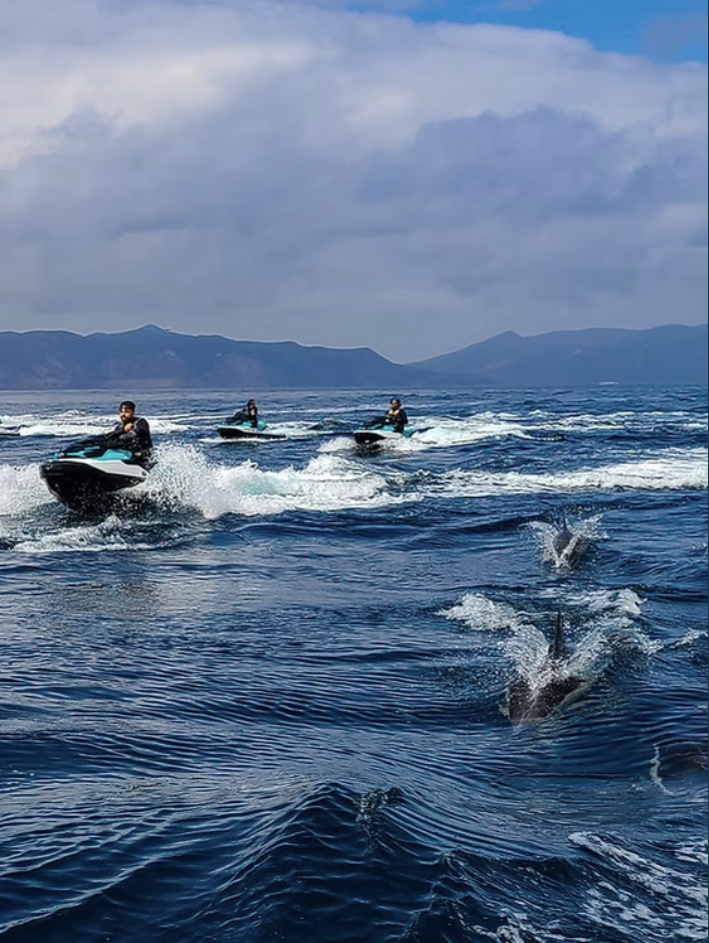
Can you see dolphins?
It is possible, but never guaranteed. The operator's promotional photos and many Catalina trips feature dolphins, and seeing them would be an incredible bonus. But the trip does not depend on dolphins. The ride, Catalina, cave swim, snorkeling, Two Harbors, and return crossing are enough.
Will you be sore afterward?
Probably. This is a physical day. Even if you feel great immediately afterward, your arms, hands, legs, shoulders, lower back, and core may have something to say the next morning. Scheduling a massage the day after is not a bad idea.
Where can readers get current information?
Use current operator booking information for the guided personal-watercraft trip, then check official Catalina and California boating resources for Two Harbors activities, island logistics, payment policies, ferry backup options, and boating safety requirements.
Official Two Harbors information

Long Beach
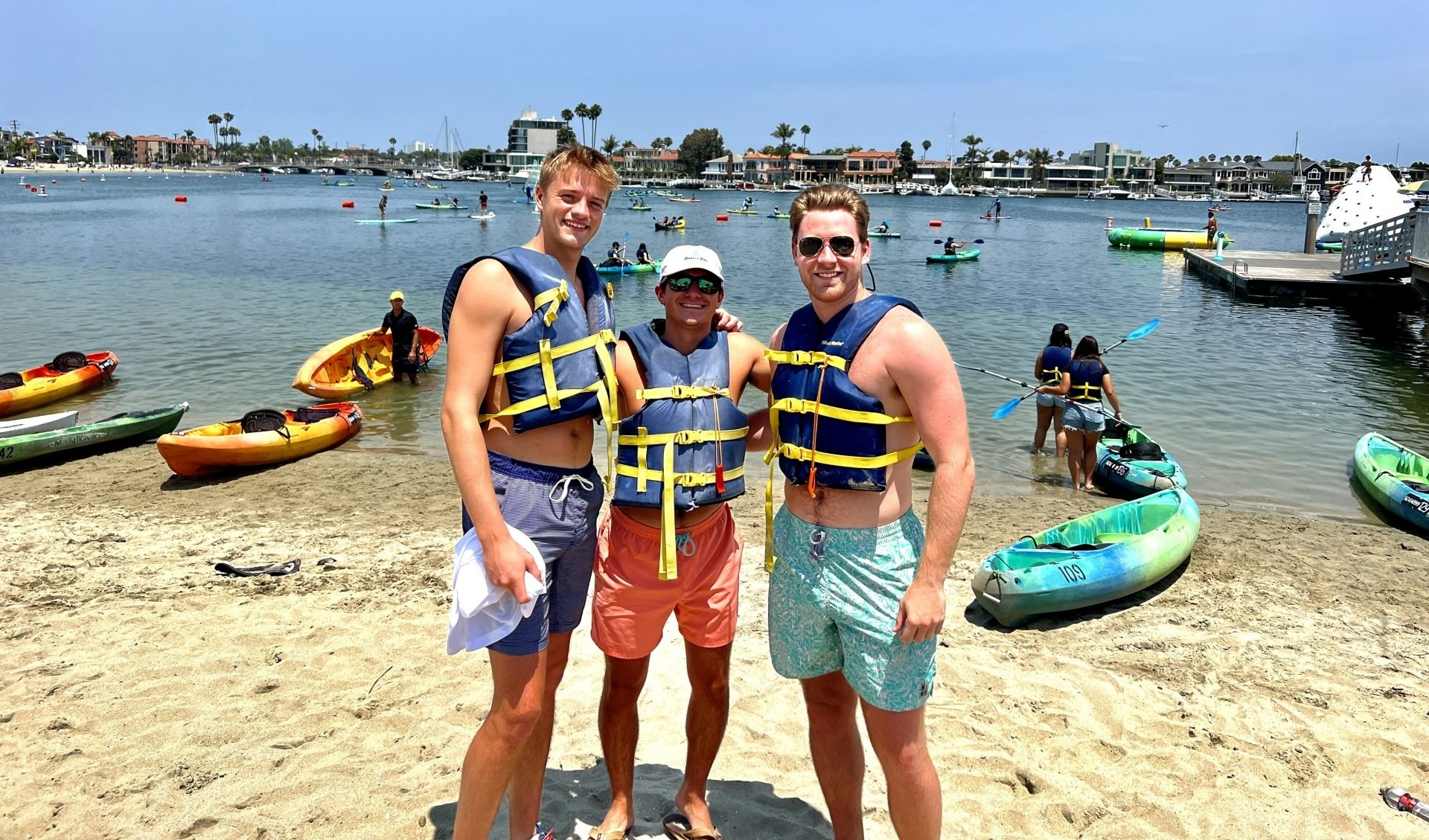
Kayak / Paddleboard Alamitos Bay and Naples Island Canals, Long Beach, CA
Plan kayaking or paddleboarding on Alamitos Bay and Naples canals with Long Beach rentals, Bay Shore Beach, moon jellies, Wibit, parking, food, and what to bring. SoCal Water Fun
Long Beach
Long Beach Alamitos Bay Marina and 2nd Street Belmont Shore
Plan an Alamitos Bay and Belmont Shore day with kayaks, paddleboards, Naples canal gondolas, Duffy boats, 2nd Street dining, parking, and current tips. SoCal Water Fun · SoCal Beaches
South Bay Beach Cities