The Huntington Library, Art Museum, and Botanical Gardens is one of the best cultural day trips near Pasadena because it combines 130 acres of public gardens, art galleries, historic estate spaces, dining, rare library collections, free parking, and enough variety for a slow full-day visit. Reservations are required on weekends, holidays, and peak seasons, so check current tickets before you go.
The Huntington Library, Art Museum, and Botanical Gardens is one of my favorite places to take friends and family when they are visiting Los Angeles.
It works because it gives people choices.
Some people want gardens.
Some people want art.
Some people want history.
Some people want a beautiful walk, a good lunch, a quiet bench, a shaded path, or a place where kids, parents, grandparents, and visitors can all find something that holds their attention.
The Huntington gives you all of that in one San Marino estate.
That is what makes it special.
It is not only a garden, even though the gardens alone could carry the day. It is not only a library, even though the library collections are extraordinary. It is not only an art museum, even though the galleries give the visit depth and elegance.
The Huntington is really a full-day experience.
It is a place to wander.
It is a place to slow down.
It is a place where the day can belong to everyone in a slightly different way.
That is why it fits so naturally into the Where Moments Matter idea. Some outings are memorable because they are loud, energetic, or unusual. The Huntington is memorable for a different reason. It gives you room to notice things.
The light through the trees.
The smell of roses in bloom.
The cool air inside a gallery on a warm Pasadena-area afternoon.
The stillness of a pond.
The surprise of turning a corner and finding a garden that feels completely different from the one you just left.
The whole place asks you to pay attention.
And if you are with people you care about, that kind of attention can turn a simple day out into something that lasts.
The Place
The Huntington is located at 1151 Oxford Road in San Marino, just a short drive from Pasadena and northeast of downtown Los Angeles.
The setting matters.
San Marino already has a quiet, residential elegance, and The Huntington feels like it belongs there. You arrive in a neighborhood that does not feel like a typical tourist corridor, then enter a property that opens into a much larger world.
The full estate covers 207 acres, with 130 acres of botanical gardens open for public enjoyment. That size is important because The Huntington does not feel like one attraction. It feels like a collection of experiences connected by paths, lawns, architecture, water, shade, galleries, and places to sit.
The gardens are usually the main draw for first-time visitors, and for good reason.
There are so many different moods here.
The Japanese Garden is one of the classic Huntington experiences, with its bridge, pond, koi, historic structures, and seasonal beauty. If you visit when the cherry blossoms are blooming, it can feel like the whole garden is quietly showing off.
The Chinese Garden has a different kind of power. It feels expansive, designed, reflective, and calm, with architecture, water, bridges, stonework, and planted views that make you slow your pace almost immediately. It is the kind of garden where you do not need to rush toward the next thing. The garden itself is the thing.
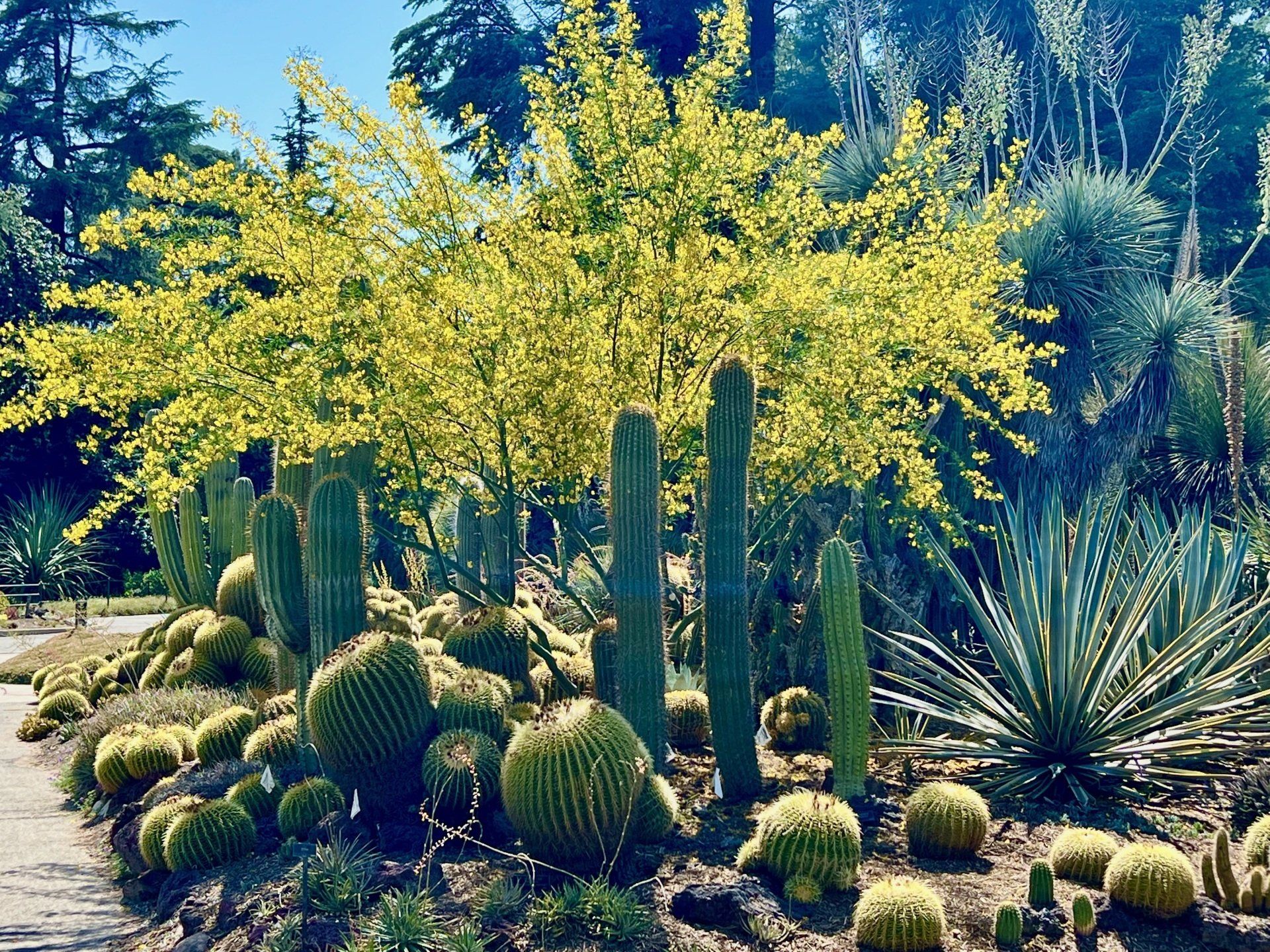
The Desert Garden may be one of the most visually dramatic parts of the property. The shapes, textures, cactus forms, succulents, flowers, and open sky create a setting that looks especially striking in Southern California light. It is also one of the best reminders that beauty does not have to be soft to be beautiful.
The Rose Garden offers a more familiar kind of pleasure, especially when it is in bloom. It is color, fragrance, paths, and the feeling that everyone suddenly wants to take one more picture.
Then there are the Camellia Garden, Shakespeare Garden, Palm Garden, Herb Garden, Jungle Garden, Lily Ponds, and other planted areas that give the property its range.
That range is one of The Huntington's great strengths.
If one garden does not completely grab someone in your group, the next one might. A person who loves flowers may be pulled toward the Rose Garden or Camellia Garden. Someone who likes design may be drawn to the Chinese Garden. Someone who loves bold shapes and photo opportunities may connect with the Desert Garden. Kids may remember the ponds, pathways, and sense of exploration more than any single plant.
The estate keeps changing too.
A March visit can feel different from a May visit. Spring flowers, camellias, cherry blossoms, roses, desert blooms, rotating exhibitions, seasonal dining, and changing light all give the place a living quality. That is part of why The Huntington rewards repeat visits.
You can spend hours there and still feel like you have not seen everything.
And honestly, that is part of the pleasure.
The Library gives the estate its intellectual weight. The Huntington is one of the great independent research libraries, currently described by The Huntington as holding 12 million items spanning the 11th through 21st centuries. Only a portion of the collection can be displayed at any one time, but the presence of that collection gives the whole property a sense of depth.
The Art Museum adds another layer. The Huntington Art Gallery occupies the former home of Henry and Arabella Huntington, which changes the way the art feels. You are not only walking through galleries. You are also moving through rooms that once belonged to the estate itself, with art, design, furnishings, and architecture working together.
That is one of the nice surprises of the visit.
After walking through warm gardens, stepping inside the galleries can feel like a graceful pause. The pace shifts. The air changes. The experience becomes quieter and more interior.
Food is part of the day too.
The 1919 Cafe near the entrance is a convenient choice with indoor and outdoor seating. Jade Court Cafe in the Chinese Garden is a good option if you want to pause deeper into the property. Red Car coffee shop, Freshwater Pavilion, and the Rose Garden Tea Room give visitors more ways to build the day around breaks instead of treating the visit like a forced march.
That matters because The Huntington is too large to enjoy well if you refuse to rest.
The best version of the visit has pauses built into it.
Walk.
Look.
Sit.
Eat.
Wander again.
Let the estate unfold instead of trying to defeat it.
The Story
What I love about The Huntington is that it works for almost everyone.
That is not easy to find.
Some Southern California outings are perfect for one kind of group and wrong for another. A hard hike may not work for young kids or older family members. A museum-only day may not work for people who need fresh air. A garden-only day may not hold the attention of someone who wants history, architecture, or art.
The Huntington solves that problem by being several experiences at once.
I have visited twice recently, once in March and once in May, and spent more than eight hours exploring the property across those visits. Even with that much time, I still did not see everything.
That is not a complaint.
That is the point.
In March, the visit was about spring flowers, camellias, the Shakespeare Garden, the Camellia Garden, and the cherry blossoms in the Japanese Garden. There was a freshness to the property, the feeling of the season arriving in color.
In May, the day became something else. The Rose Garden, Desert Garden, and Chinese Garden pulled more attention. There was more time to enjoy the Library and the Huntington Art Gallery. The visit felt less like a repeat and more like a second chapter.
That is what makes The Huntington such a good place to bring visitors.
You do not have to design one perfect route for everyone.
You can let the group find its own rhythm.
Maybe you start with the Palm Garden near the entrance and let the tall trees give everyone a sense of arrival. Maybe you move toward the Rose Garden and Tea Room because someone in the group loves flowers. Maybe the Desert Garden becomes the surprise favorite because the shapes and colors are so different from what visitors expect. Maybe the Chinese Garden becomes the place where everyone slows down at the same time.
The route matters less than the pace.
The biggest mistake is trying to see everything.
The estate is too large for that kind of visit. You can technically move from one thing to the next, checking off gardens, galleries, dining stops, and landmarks, but that is not the best way to experience The Huntington.
If the Library interests you, give it time and then add a few gardens.
If the galleries are the priority, choose the ones that matter most and treat the gardens as the beautiful connective tissue between them.
If you are with children, build the day around movement, shade, water, food, and discovery instead of expecting everyone to read every label.
If you are with out-of-town guests, let them feel the scale of the place.
That is often what impresses people first.
The Huntington is not a small garden tucked beside a museum. It is a major estate, maintained with obvious care by a large community of staff and volunteers. You feel that care everywhere: in the roses, in the paths, in the buildings, in the ponds, in the galleries, in the way the grounds keep presenting one more view.
The Art Gallery is especially worth including if you have time.
Because it was once the Huntington residence, it does not feel like a neutral museum box. It feels like a home that became a museum, which makes the experience more personal. The rooms, furnishings, paintings, and decorative arts all help you imagine the estate as both a private world and a public institution.
That is a rare combination.
And if the day is warm, which it often can be near Pasadena and San Marino, the galleries also give you a practical gift: a chance to cool down and reset before returning to the gardens.
That is another reason to pace the visit well.
The Huntington rewards curiosity, but it also rewards common sense.
Wear comfortable shoes. Bring water. Check the weather. Plan a food break. Look at the map before you go. Accept that you will not see everything in one visit.
Once you accept that, the day gets better.
You stop rushing.
You start noticing.
And that is when The Huntington becomes memorable.
The Reflection
Some places are impressive because of scale.
Some are impressive because of beauty.
Some are impressive because of history.
The Huntington has all three, but the thing that makes it emotionally useful is the way it lets different people share the same day without needing the exact same experience.
That is a bigger deal than it sounds.
When you are hosting visitors, planning a family outing, or trying to choose something that works for a mixed group, you are really trying to solve for energy, interest, age, mobility, weather, food, attention span, and mood.
The Huntington gives you options inside one place.
A person can love the gardens.
Another can love the art.
Another can love the history.
Another can love the lunch.
Another can simply love walking somewhere beautiful.
And somehow, all of that belongs.
That is why the experience can feel generous.
It does not demand that everyone respond to the same thing in the same way. It gives everyone enough room to have their own small moment, then brings the group back together as the day moves along.
Maybe the moment is standing by the koi pond.
Maybe it is smelling the roses.
Maybe it is seeing a rare book or manuscript and remembering how long human beings have been trying to preserve ideas.
Maybe it is stepping into the Huntington Art Gallery and realizing that the building itself is part of the story.
Maybe it is sitting down for lunch after a long walk and watching everyone relax.
Those are not complicated moments, but they are real ones.
The Huntington also teaches a quiet lesson about pace.
You cannot really absorb the place by rushing through it. You have to let go of the need to see everything. You have to choose, wander, pause, and leave a few things for next time.
That may be the best way to visit.
Not as a checklist.
As a day.
The Huntington is beautiful, but the beauty is not only in the flowers, galleries, or buildings. It is in the way the place creates space for people to be curious together.
That is the Where Moments Matter thread here.
You come for the gardens, the library, the art, or the estate.
But the memory may be simpler than that.
It may be the walk.
The conversation.
The bench.
The shared discovery.
The feeling that, for a few hours, nobody needed to hurry.
Whether you go alone, with your spouse, your kids, your family, your friends, or someone you simply want more time with, be present and make it a "Where Moments Matter" day.
You come for The Huntington.
You leave with a moment that lasts.
That is the whole point.
Where moments matter.
FAQs
Where is The Huntington?
The Huntington is located at 1151 Oxford Road, San Marino, CA 91108, near Pasadena and northeast of downtown Los Angeles.
What are The Huntington's current hours?
The Huntington's regular public hours are 10 a.m. to 5 p.m., Wednesday through Monday. It is closed on Tuesdays. As checked July 13, 2026, The Huntington also notes that special and seasonal exceptions can apply, including Labor Day 2026 hours. Check the official visit page before going.
Do you need reservations or advance tickets?
Reservations are currently required Friday through Sunday, on holidays, and during peak seasons. Your ticket is valid for the selected day, your ticket time is your earliest arrival time, and check-in currently closes at 4:15 p.m. Peak-season rules and special-event rules can change, so confirm before visiting.
How much is admission?
As checked July 13, 2026, adult admission is listed at $29 Monday through Thursday and $34 Friday through Sunday, holidays, and peak seasons. The Huntington also lists senior, military, student, youth, Museums for All, child, member, and college-card pricing on the official visit page.
Is parking free?
Yes, The Huntington currently lists parking as free, but parking can reach capacity on weekends, holidays, and peak seasons. Carpooling or rideshare is strongly encouraged during busy periods. Entrances are on Oxford Road and Allen Avenue.
How much time should you spend at The Huntington?
Plan at least three to four hours for a first visit, and longer if you want lunch, tea, galleries, and multiple gardens. It is very easy to spend most of the day there.
What is currently closed at The Huntington?
As checked July 13, 2026, The Huntington lists the Library exhibition halls as temporarily closed during the Library/Art Building project, along with select galleries, the Ranch Garden, the Mausoleum, and the Desert Garden Conservatory during the summer months when temperatures can exceed safe levels. The Kitchen Garden is listed as open Saturdays and Sundays only. Closures can change, so check the official visit page before going.
Can you see everything in one visit?
Probably not in a relaxed way. The property is large, and the best visit usually comes from choosing a few priorities instead of trying to cover every garden, gallery, and stop in one day.
What should first-time visitors see?
For a first visit, consider the Japanese Garden, Chinese Garden, Rose Garden, Huntington Art Gallery, and at least one food or coffee stop. Use the official map to choose a route that fits your group, the weather, and current garden or gallery closures.
Are the Library exhibition halls open?
As checked July 13, 2026, The Huntington's Library exhibition halls are temporarily closed during the Library/Art Building project. The gardens, art galleries, exhibitions, programs, and rare library materials displayed elsewhere across campus remain open. The Library exhibition halls are anticipated to reopen to the public in spring 2029.
What food options are available?
Current dining options include 1919 Cafe, Red Car coffee shop, Freshwater Pavilion, Jade Court Cafe, and the Rose Garden Tea Room. Admission is not required to dine at 1919 Cafe or Red Car coffee shop. Dining hours and menus can change, so check the official dining page before going.
What should you bring for a Huntington visit?
Wear comfortable closed-toe walking shoes, bring water, sun protection, and a flexible route. In warm weather, plan shade and air-conditioned breaks; The Huntington specifically encourages hydration and breaks during extreme heat.
Do you need reservations for the Rose Garden Tea Room?
Dining reservations are strongly recommended for the Rose Garden Tea Room. Check the official dining page for current menus, hours, reservation links, and holiday closures.
Are there tours?
Yes. The Huntington offers specialty tours, group tours, free garden tours, art spotlight conversations, school tours, virtual tours, and digital guide options. Free garden tours are currently offered with admission or membership, subject to docent availability, and cannot be reserved in advance.
Can you take photos at The Huntington?
Personal vacation-style snapshots and videos are allowed. Posed portrait photography requires advance scheduling as a Portrait Photography Session, a fee, and a city permit, and walk-up requests are not accepted. Drones and selfie sticks are not permitted, flash is not allowed inside, and tripods or monopods are allowed only in limited outdoor personal nature contexts. Check the official photography policy before planning any special shoot.
Can you bring outside food or picnic in the gardens?
The Huntington currently says no picnicking is allowed in the gardens and no outside alcoholic beverages are permitted. Limited picnic tables are available outside the garden admission area in Barth Family Grove and the Children's Picnic Area, and admission is not required to dine at 1919 Cafe or Red Car coffee shop. Check the official dining and visit pages for current policies.
Are pets allowed?
No. Pets are not permitted at The Huntington, with the exception of ADA-defined service animals.
Is The Huntington accessible?
The Huntington provides accessibility information for visitors, and the visitor shuttle runs during regular public hours from 10 a.m. to 5 p.m. on a counter-clockwise loop with eight stops. The shuttle is accessible and can accommodate wheelchairs. Review the current accessibility page and map before visiting if anyone in your group has mobility or access needs.
Where can readers get tickets, details, or current information?
Start with the official Huntington pages:

Pasadena / San Gabriel Valley
Descanso Gardens
Plan a Descanso Gardens visit in La Canada Flintridge with tickets, hours, free parking, roses, camellias, cherry blossoms, garden rules, food, and photo tips. SoCal Out Of The Ordinary · SoCal Hiking
Palm Springs
Drag Queen Bingo in Palm Springs
Plan a Drag Queen Bingo night in Palm Springs with Hunters, Arenas Road nightlife, event schedule notes, group tips, drinks, comedy, and what to confirm before you go. SoCal Out Of The Ordinary · SoCal Comedy
Hollywood / Central Los Angeles